
TL;DR:
- Precise measurement of the inner graphic field is essential for a perfect emblem overlay fit.
- Curvature, mounting style, and badge variations across models significantly affect overlay application.
- Proper sizing and material choice ensure durability and a factory-like appearance for vehicle badges.
Ordering an emblem overlay that doesn't fit is one of the most frustrating experiences a Subaru or Ford owner can face. You pick a design you love, wait for it to arrive, and then discover it's either too small, too large, or just slightly off in a way that makes it look worse than the stock badge. The root cause almost every time? Measuring the emblem the wrong way. This guide walks you through exactly how to measure your badge's graphic field, explains the real-world size benchmarks for popular models, and covers the subtle fitting challenges that trip up even experienced customizers.
Table of Contents
- Why precise emblem overlay sizing matters
- How to measure your Subaru or Ford badge correctly
- Common Subaru and Ford emblem sizes: Real-world examples
- Fitting challenges: Curvature, pins, and edge cases
- Overlay materials and durability: What to expect
- Our take: Measurement is the skill nobody talks about
- Find the perfect overlay for your Subaru or Ford
- Frequently asked questions
Key Takeaways
| Point | Details |
|---|---|
| Measure the blue field | Ignore the chrome bezel and focus only on the colored field when measuring for overlays. |
| Year and model affect size | Even small differences between years or badge locations can change size and fit dramatically. |
| Curvature and mounting matter | Always consider the shape, pins, and mounting style to prevent peeling or misfit overlays. |
| UV laminate extends lifespan | A UV-protected overlay can last up to five years outdoors with proper prep. |
Why precise emblem overlay sizing matters
Most people assume that measuring an emblem is simple. You grab a ruler, measure across the badge, write down the number, and order accordingly. The problem is that this approach captures the wrong dimension entirely.
Factory OEM badges are measured tip-to-tip, which includes the chrome bezel or outer ring that frames the graphic. Overlay products, on the other hand, are sized to fit only the inner colored or graphic field, sometimes called the "blue field" on Ford and Subaru badges. These two measurements can differ by half an inch or more, which is enough to cause a complete misfit.
Here is why that gap creates real problems:
- An overlay sized to the full badge width will hang over the chrome edge, creating a visible lip that catches dirt and peels within weeks.
- An overlay sized too small leaves exposed badge area around the edges, making it look like a sticker slapped in the wrong place.
- A slightly misaligned overlay can cover alignment pins or mounting tabs, making future badge removal much harder.
"Precise sizing is critical; measure the blue field excluding the chrome bezel for overlays, as OEM catalogs use tip-to-tip including bezel."
Getting this right the first time saves you money, protects your badge, and produces a result that looks factory-installed rather than DIY. If you want a broader overview before going deeper, a practical guide to overlay sizing is a solid starting point for understanding the full process.
How to measure your Subaru or Ford badge correctly
Now that you know why it matters, here is how to get a precise measurement every time. The process is straightforward, but a few details make the difference between a perfect fit and a frustrating return.
Step-by-step measurement process:
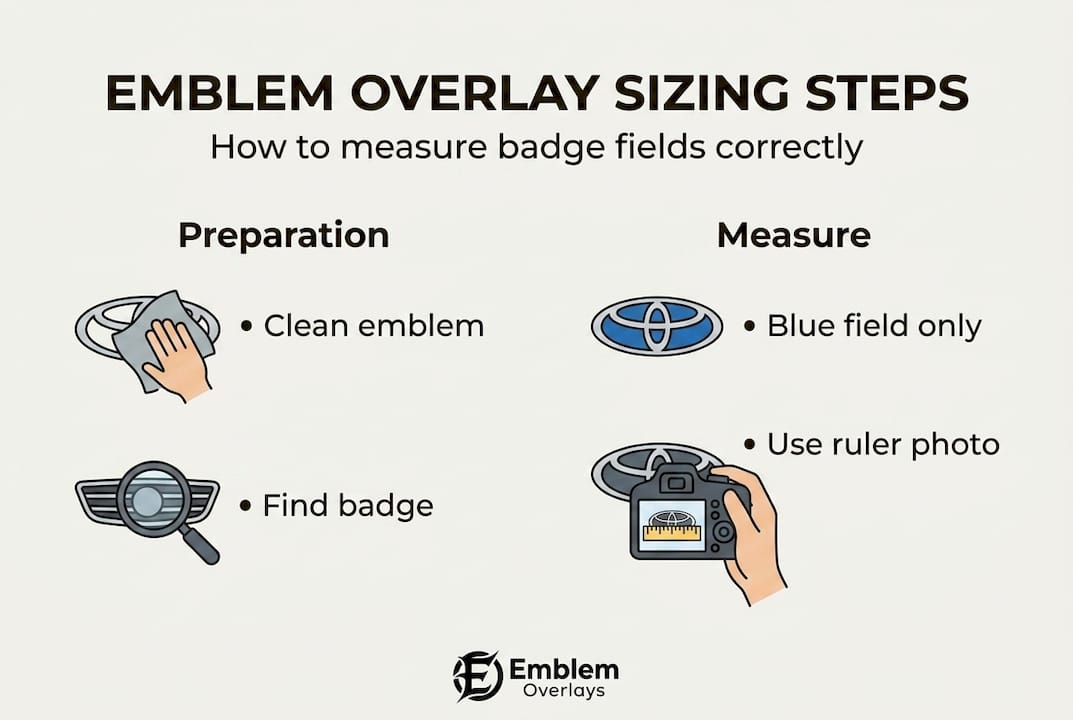
- Clean the badge first. Dust, wax residue, and grime can throw off your measurement by a few millimeters. Use a microfiber cloth and a mild cleaner before you start.
- Identify the blue or graphic field. This is the colored inner area of the badge, not the chrome outer ring. On Ford ovals, it is the blue center. On Subaru star cluster badges, it is the silver graphic field inside the outer frame.
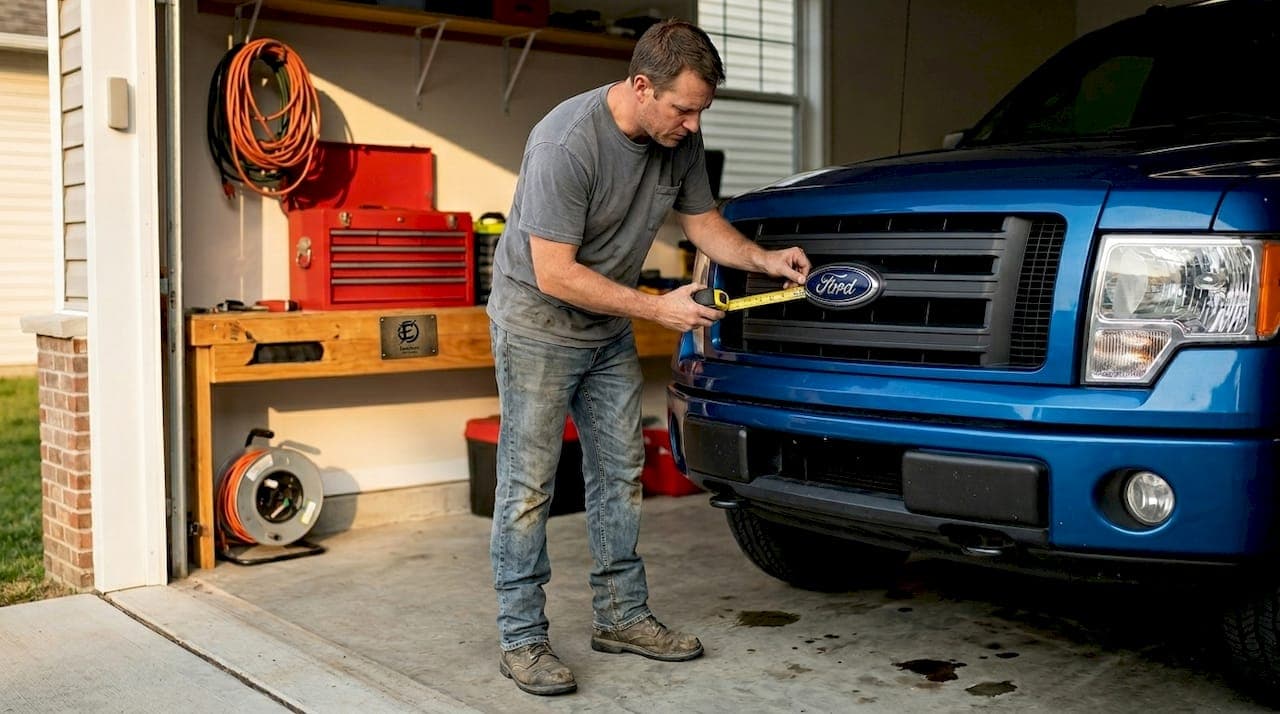
- Use a flexible tape measure. A rigid ruler cannot follow any curvature in the badge surface. A flexible sewing tape measure or a piece of string that you then measure against a ruler works well.
- Measure width first, then height. Record both dimensions in inches and millimeters. Most overlay products list sizes in millimeters, so having both units handy prevents conversion errors.
- Measure at the widest point of the graphic field. Do not measure diagonally or at an angle. Go straight across the widest horizontal point, then straight down the tallest vertical point.
- Note the badge location. Grille badges and tailgate badges on the same vehicle often have different dimensions. Measure each one separately.
"Always measure your specific badge's blue field precisely using the tape method to avoid misfit; verify model and year compatibility as sizes change."
Pro Tip: Take a photo of the badge with a ruler or tape measure visible in the frame. This gives you a visual reference you can compare against product photos when shopping, and it is especially useful if you are ordering for multiple vehicles at once.
Before you order, it is worth reviewing the stepwise measurement process in detail, and making sure you know how to prep your emblem for overlay application so adhesion holds long-term.
Common Subaru and Ford emblem sizes: Real-world examples
With the process clear, let us look at how measurements play out on actual Ford and Subaru models. These benchmarks are useful as a sanity check after you measure your own badge, but they should never replace measuring your specific vehicle.
Ford F-150 and oval badge sizes
Ford oval badges are among the most commonly overlaid emblems on the market, and they come in more size variations than most people realize. The grille badge is almost always larger than the tailgate badge, and sizes shifted noticeably in 2015 when Ford redesigned the F-150.
| Model and location | Year range | Approximate blue field size |
|---|---|---|
| F-150 grille | 2004 to 2014 | 9 in x 3.5 in (229 x 89 mm) |
| F-150 grille | 2015 to 2020 | 9.5 in x 3.8 in (241 x 97 mm) |
| F-150 tailgate | 2004 to 2014 | 7 in x 2.75 in (178 x 70 mm) |
| Wheel center cap | Various | Varies, measure individually |
According to real-world Ford sizing data, common overlay sizes available for Ford ovals include 125x50mm, 145x60mm, and 241x97mm options, so matching your measurement to the nearest available product size is usually straightforward.
For a deeper look at how these sizes affect your options, the Ford F-150 emblem sizing breakdown covers trim-specific variations worth knowing.
Subaru emblem sizes
Subaru badges present a different challenge because the star cluster design has changed shape and size across generations. The outer chrome ring is prominent, making it easy to accidentally measure the full badge instead of the inner graphic field.
| Model and location | Year range | Approximate graphic field size |
|---|---|---|
| Forester front grille | 2014 to 2016 | 6.7 in x 3.7 in (170 x 94 mm) |
| Forester front grille | 2017 to 2018 | Smaller, measure individually |
| Outback front | 2015 to 2019 | Varies by trim |
| Crosstrek front | 2018 to 2022 | Varies by trim |
Empirical data from Subaru owners confirms that the Subaru Forester 2014 to 2016 front emblem is approximately 6.7x3.7in, with later model years coming in noticeably smaller. This is a significant enough change that an overlay sized for a 2015 Forester will not fit a 2018 model.
The Subaru Forester sizing guide goes into generation-by-generation detail that is worth reviewing before you finalize your order.
A useful rule of thumb: If your measurement falls between two available overlay sizes, always go with the smaller option. An overlay that is slightly smaller than the graphic field looks intentional. One that is slightly too large will show edge gaps and peel faster.
Fitting challenges: Curvature, pins, and edge cases
Knowing standard sizes is not enough. You also need to account for subtler fitment challenges that can make a correctly sized overlay fail in practice.
Badge curvature
Grille badges on most Ford and Subaru vehicles have a convex curve, meaning the center of the badge is higher than the edges. Tailgate badges are often much flatter. An overlay designed for a flat surface will lift at the edges when applied to a curved badge, no matter how precisely it was sized.
Here is what to watch for:
- Grille badges on F-150 models from 2015 onward have a noticeable convex curve. Overlays for these badges need to be flexible enough to conform without creating air pockets.
- Tailgate badges are generally flatter and more forgiving, but the surface texture can vary.
- Wheel center caps require a perfectly round, smooth surface. Any debris or raised texture will prevent full adhesion and cause the overlay to bubble or peel.
"Emblem curvature mismatch between grille convex and tailgate flat surfaces causes edge lift; alignment pin spacing varies by year, preventing interchange between model years."
Alignment pins and mounting evolution
Ford and Subaru have changed how their badges mount to the vehicle multiple times over the years. Early models used simple adhesive. Later models added alignment pins. More recent designs use a combination of pins and bolts. This matters because:
- Alignment pins take up space on the badge surface. If an overlay covers a pin hole, it may not sit flush.
- Badges from different years are not always interchangeable, even if they look similar.
- Aftermarket badges sometimes have different pin spacing than OEM units, which affects overlay fit.
Pro Tip: Before ordering, look up your specific model year's badge mounting style. A quick search for your vehicle's badge removal process will tell you whether pins are present and where they sit relative to the graphic field.
The Ford badge overlay types guide covers how different mounting configurations affect overlay selection.
Overlay materials and durability: What to expect
After focusing on sizing and fit, do not overlook the role of materials and durability in long-term satisfaction. A perfectly fitted overlay made from low-quality vinyl will still look terrible within a year.
Vinyl types and expected lifespan
Not all automotive vinyl is created equal. The base material, thickness, and surface coating all affect how long your overlay holds up against sun, rain, car washes, and temperature swings.
Here is what the data shows:
- Standard cast vinyl lasts roughly 1 to 3 years in outdoor conditions, depending on climate and sun exposure.
- UV laminated vinyl can extend that lifespan up to 5 years with proper application and care.
- Calendered vinyl is thicker and less conformable, making it a poor choice for curved badge surfaces.
For a full breakdown of what vinyl overlays can do for your vehicle's appearance, the vinyl overlay benefits article is worth reading. And if you drive in harsh weather, the overlay durability in all weather guide covers what to expect across seasons.
Practical tips for maximizing longevity
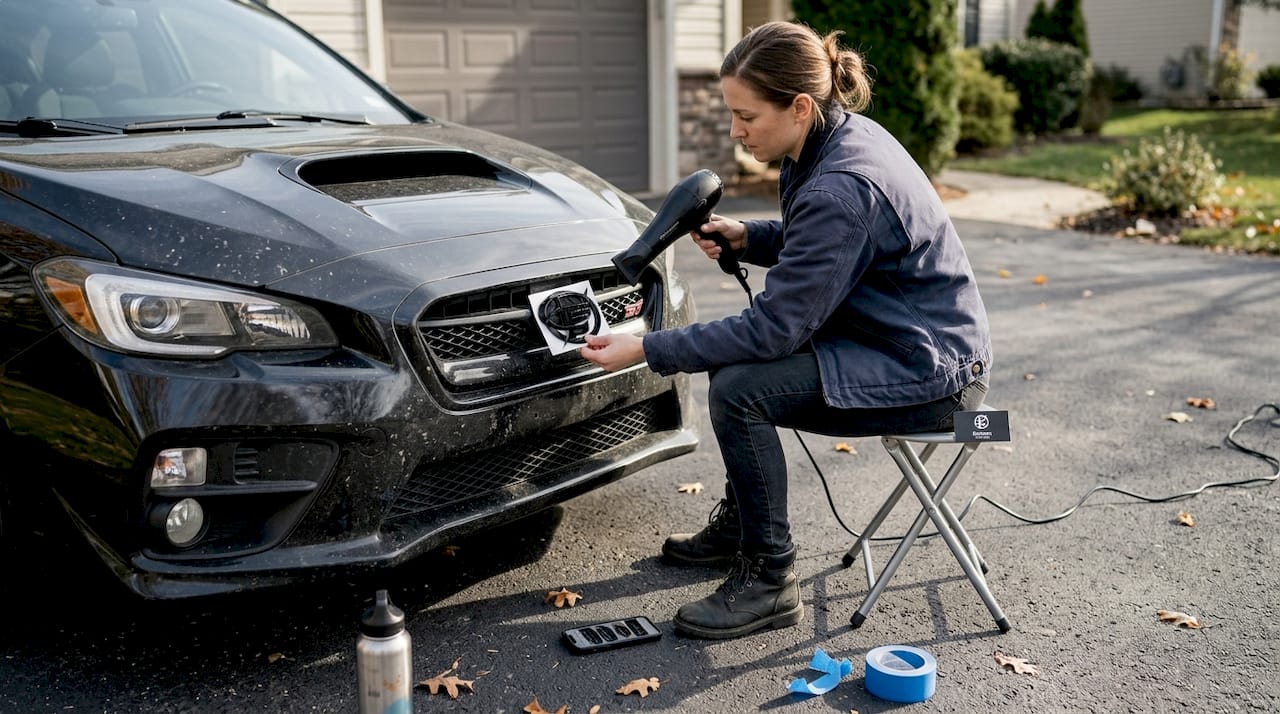
- Clean the badge surface with isopropyl alcohol before application. Any wax or silicone residue will prevent the adhesive from bonding fully.
- Apply overlays in moderate temperatures, ideally between 60°F and 80°F. Cold vinyl does not conform well, and hot surfaces cause premature adhesive activation.
- Avoid high-pressure car washes aimed directly at the badge for the first week after application.
- Reapply a thin layer of automotive wax around the overlay edges every few months to seal against moisture intrusion.
Pro Tip: UV laminate overlays are worth the small price premium if your vehicle sits outdoors regularly. The laminate layer blocks the UV rays that degrade color and cause vinyl to crack, which is the most common reason overlays fail before their expected lifespan.
Our take: Measurement is the skill nobody talks about
Here is something the broader customization community rarely says out loud: most overlay failures are not product failures. They are measurement failures. We see this constantly. A customer orders an overlay, it does not fit, and the instinct is to assume the product was wrong. But when we walk through the measurement process with them, it almost always turns out they measured the full badge including the chrome bezel, or they measured the grille badge and ordered the same size for the tailgate.
The uncomfortable truth is that badge sizing is genuinely confusing because manufacturers do not standardize it. Ford measures their badges one way for catalog purposes. Aftermarket suppliers measure them another way. And the overlay market uses yet another reference point. Nobody is wrong exactly, but the lack of a shared standard creates real confusion for buyers.
Our advice: treat measurement as a skill worth developing, not a quick checkbox. Spend five minutes doing it carefully, double-check by comparing your numbers against known benchmarks for your model year, and then order with confidence. The overlays themselves are the easy part. Getting the measurement right is what separates a clean, professional-looking result from a frustrating return.
Find the perfect overlay for your Subaru or Ford
You have done the hard work of understanding sizing. Now it is time to find a design that actually reflects your style.
At Emblem Inlays, we make vinyl emblem overlays specifically designed to fit Subaru and Ford factory badges. Our catalog includes hundreds of designs, from clean solid colors to all 50 state flags, so you can represent your home state right on your grille or tailgate. Every overlay is sized to fit the graphic field of your badge, not the full bezel, which means when you match your measurement to our size listings, you get a fit that looks factory-installed. Browse our full collection of emblem overlays and find the design that makes your vehicle yours.
Frequently asked questions
How do I know which emblem size my car needs for an overlay?
Measure only the blue or graphic field of your actual badge, not the full tip-to-tip width including the chrome bezel, because OEM catalogs measure tip-to-tip while overlays are sized to the inner field only.
Why won't overlays fit both my grille and tailgate emblems?
Grille and tailgate badges can have different sizes, shapes, and curvatures even on the same model year, and curvature mismatch between locations is one of the most common causes of edge lift and poor adhesion.
Is there a standard Subaru Forester emblem overlay size?
No, Subaru Forester emblems vary by generation. The 2014 to 2016 front emblem measures approximately 6.7x3.7in, while 2017 and 2018 models are noticeably smaller, so always measure your specific vehicle.
How long will a vinyl emblem overlay last on my car?
Standard vinyl overlays typically last 1 to 3 years outdoors, but UV laminate extends lifespan up to 5 years when the badge surface is properly cleaned and prepped before application.