
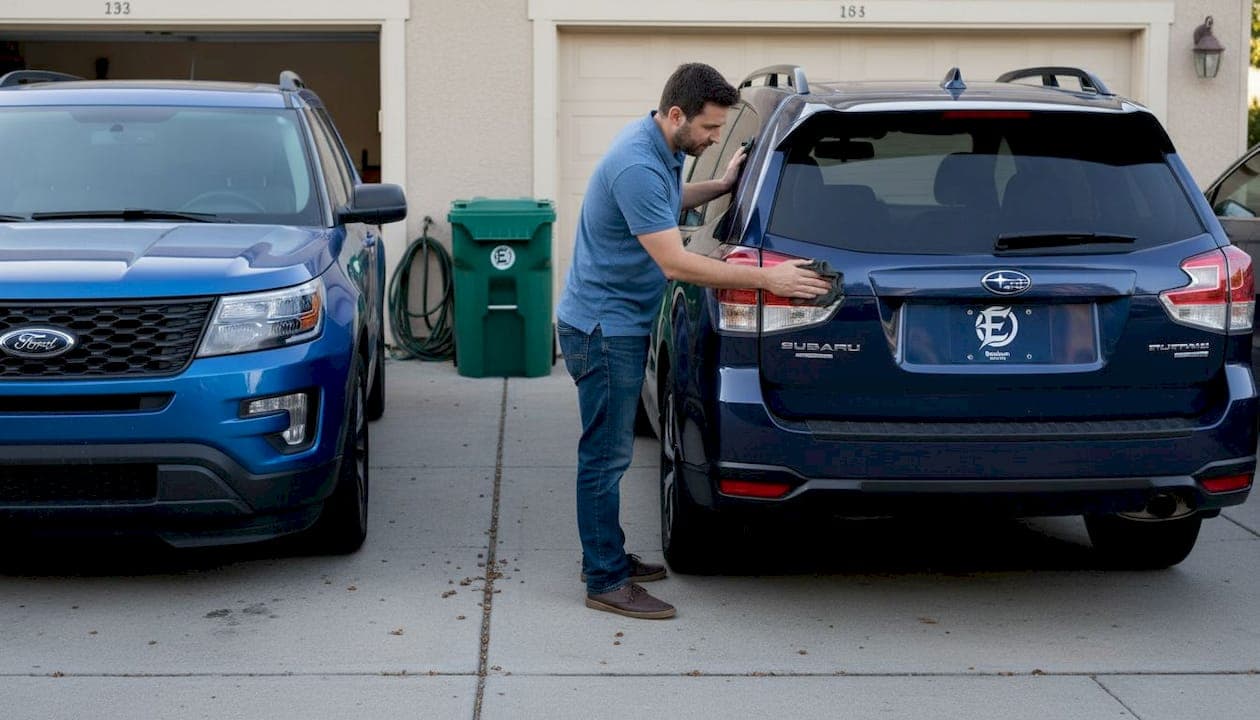
Most car owners glance at their emblem every single day without giving it a second thought. But for Subaru and Ford drivers, that badge carries real weight. It represents decades of engineering heritage, a community of passionate owners, and a quiet statement about who you are. Car emblems symbolize brand identity, loyalty, and personal expression in ways that go far deeper than most people realize. This guide walks you through the history behind these iconic badges, the materials and methods behind modern overlays, and how you can personalize your vehicle without sacrificing warranty protection or resale value.
Table of Contents
- Understanding car emblems: More than a logo
- What are emblem overlays? Materials and methods explained
- Comparing overlay types: Vinyl vs ABS plastic
- Installation tips for overlays: What every Subaru and Ford owner should know
- Why overlays matter: Warranty, reversibility, and expression
- Start your emblem upgrade: Custom overlays for Subaru and Ford
- Frequently asked questions
Key Takeaways
| Point | Details |
|---|---|
| Emblems are identity | Subaru and Ford emblems stand for heritage, loyalty, and community for car owners. |
| Overlays are safe and reversible | Custom overlays personalize appearance, keep warranties intact, and allow easy style changes. |
| Choose the right material | Vinyl is budget-friendly and flexible, ABS plastic lasts longer and is more durable. |
| Proper install is critical | Thorough cleaning, precise alignment, and correct heating ensure overlays last and look professional. |
Understanding car emblems: More than a logo
Subaru's six-star cluster is not random. It represents the Pleiades star cluster, which is the Japanese name for Subaru, and it visually maps out the six companies that merged to form Fuji Heavy Industries. Every time you see that badge, you are looking at a piece of corporate history turned into art. Ford's blue oval, on the other hand, has been a symbol of American manufacturing since 1927, and it carries a brand identity and symbolism that has earned a 50% customer loyalty rate among its buyers.
These emblems do more than identify a manufacturer. They create belonging. Subaru owners wave at each other on the road. Ford truck owners form clubs, attend rallies, and trade stories about their rigs. The badge is the entry point to that community.
"An emblem is not just a logo on metal. For many owners, it is the first thing they personalize because it is the most visible expression of who they are as a driver."
That emotional connection is exactly why so many owners explore Subaru and Ford emblem art as a starting point for customization. And when it comes to making changes, most enthusiasts prefer overlays over permanent modifications. The debate between factory vs custom emblems usually comes down to a few key factors:
- Reversibility: Overlays can be removed without damaging the original badge.
- Cost: Overlays are far more affordable than full emblem replacements.
- Resale value: Keeping the OEM emblem underneath protects the vehicle's original look.
- Warranty safety: No permanent alteration means no warranty risk.
- Variety: Hundreds of designs are available, from state flags to custom color schemes.
With the deep meaning behind these badges, personalization becomes even more impactful. Next, let's look at how overlays make that possible.
What are emblem overlays? Materials and methods explained
An emblem overlay is a precision-cut cover that fits directly over your factory badge. Custom emblem overlays use vinyl wraps or ABS plastic applied over OEM emblems via peel-and-stick adhesive, making them one of the simplest upgrades you can do in your driveway. The result looks factory-fresh but entirely your own.
The two main materials each have a distinct personality. Air-release vinyl is flexible, lightweight, and available in an enormous range of colors, finishes, and printed designs. ABS plastic overlays are molded to match the exact contours of your emblem and offer a more rigid, premium feel. Both have real advantages depending on your priorities.
Here is a quick comparison to help you decide:
| Feature | Air-release vinyl | ABS plastic |
|---|---|---|
| Flexibility | High | Low |
| Finish options | Hundreds | Limited |
| Durability | 1 to 5 years | 5 to 7+ years |
| Cost | Lower | Higher |
| Installation ease | Easy | Moderate |
| Reversibility | Very easy | Easy |
Installation is straightforward when you follow the right steps. The overlay enhancement benefits are maximized when you take your time during setup. Here is the basic process:
- Clean the emblem surface thoroughly with isopropyl alcohol.
- Let the surface dry completely before touching the overlay.
- Align the overlay carefully before committing to placement.
- Use the dry method for convex emblems to avoid air bubbles.
- Press firmly from the center outward using a squeegee or credit card.
- Apply gentle heat with a hairdryer to activate the adhesive.
- Wait at least 15 minutes before removing any transfer tape.
Pro Tip: Always install overlays in a shaded area at room temperature. Direct sunlight heats the adhesive too quickly and makes precise alignment nearly impossible. For convex emblems like Subaru's star cluster, the dry install method gives you far more control than wet mounting.
The world of automotive personalization has grown significantly, and overlays are one of the most accessible entry points. Now that you know what overlays are made of and how they are installed, let's look at how they perform over time.
Comparing overlay types: Vinyl vs ABS plastic
Choosing between vinyl and ABS plastic is not just about looks. It is about how you use your vehicle and where you live. If you park outside year-round in a state with harsh winters or blazing summers, material choice matters a lot.
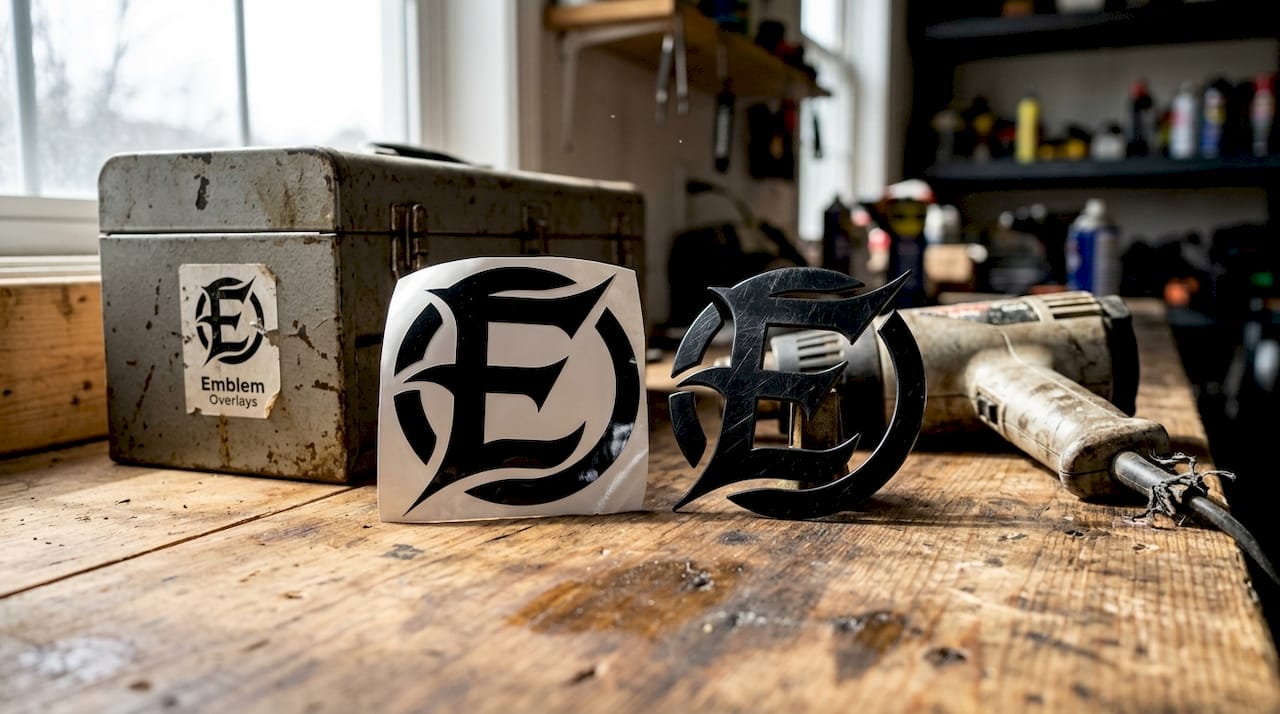
Vinyl overlays are the go-to for most Subaru and Ford owners because of their flexibility and variety. They conform to curved surfaces easily, they are carwash-safe, and they come in UV-resistant formulations. The tradeoff is that vinyl overlays last 1 to 5 years while ABS plastic overlays can last 5 to 7 or more years under the same conditions.
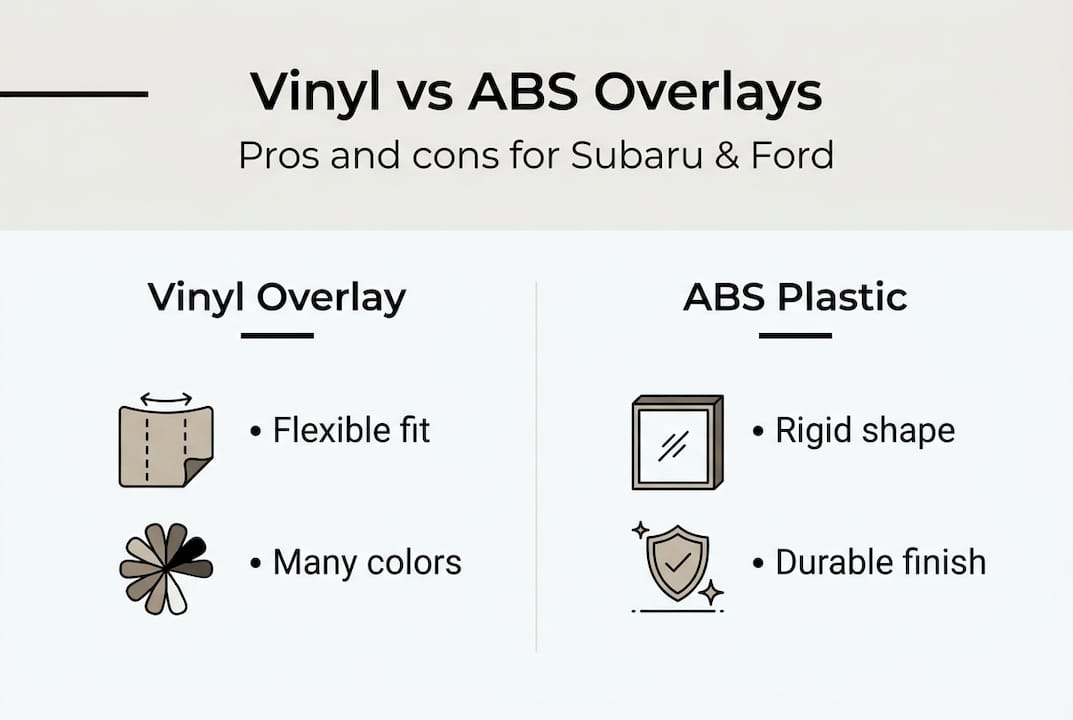
Here is a side-by-side breakdown of real-world performance:
| Condition | Vinyl overlay | ABS plastic overlay |
|---|---|---|
| Extreme heat | May soften or peel | Holds shape well |
| Extreme cold | Can become brittle | More stable |
| UV exposure | UV-resistant grades available | Naturally resistant |
| Sensor-equipped emblems | Safe if under 0.3mm | Check thickness |
| Carwash compatibility | Yes | Yes |
One thing most people overlook is sensor compatibility. Modern Subaru and Ford vehicles use front-mounted radar sensors for features like adaptive cruise control and automatic emergency braking. If you use a thick or metallic vinyl overlay on a sensor-equipped emblem, you risk interfering with those systems. Always check the all-weather overlay guide for sensor-safe recommendations before buying.
Key points to keep in mind when comparing overlay types:
- Vinyl is better for frequent style changes and budget-conscious owners.
- ABS plastic is better for long-term installs and premium aesthetics.
- Both types work on Subaru star clusters and Ford oval badges.
- Proper surface prep extends the life of either material significantly.
- A detailed ABS vs vinyl comparison can help you match material to your specific climate.
Once you have chosen the right material, getting the installation right is the next step.
Installation tips for overlays: What every Subaru and Ford owner should know
A great overlay installed poorly will look worse than a budget overlay installed well. The difference is almost always in the prep work. Rushing the cleaning step or skipping alignment checks are the two most common reasons overlays fail early.
Here is a step-by-step process built specifically for Subaru and Ford emblems:
- Gather your tools: overlay, isopropyl alcohol wipes, a squeegee or old credit card, a hairdryer, and a tape measure.
- Clean the emblem with isopropyl alcohol and let it dry for at least five minutes.
- Hold the overlay against the emblem without removing the backing to check alignment.
- For Subaru's six-star cluster, align each star individually before pressing down.
- For Ford's script or oval, use the tape measure to center the overlay precisely.
- Peel the backing slowly and press from the center outward.
- Use the hairdryer on low heat to conform the overlay around any curves or edges.
- Wait 15 minutes before removing transfer tape, per installation best practices.
Pro Tip: For front emblems on vehicles with radar sensors, always use thin vinyl under 0.3mm. This keeps your safety systems working perfectly while still giving you the custom look you want. Check out the full range of Ford overlay options to find sensor-safe designs.
Common mistakes to avoid include installing in direct sunlight, skipping the alcohol wipe, using too much heat, and pressing down before alignment is confirmed. Each of these mistakes is easy to avoid and makes a real difference in how long your overlay lasts. For tricky situations, install troubleshooting resources can walk you through fixes.
Why overlays matter: Warranty, reversibility, and expression
Permanent modifications to your vehicle's exterior can create real headaches, especially if you lease your car or plan to sell it within a few years. Overlays solve that problem entirely. Overlays enhance aesthetic appeal reversibly without voiding your warranty as long as no damage is caused during installation or removal.
This makes overlays the smart choice for a wide range of owners:
- Lease drivers who need to return the vehicle in original condition.
- New car owners who want to personalize without risking their warranty.
- Enthusiasts who like to change their look with the seasons or new trends.
- Resale-focused owners who want to keep the OEM badge intact underneath.
- Community members who want to show pride in their Subaru or Ford identity.
"The best modification is one you can undo. Overlays let you express yourself fully today without locking yourself into that choice forever."
The range of expression available through overlays is genuinely impressive. You can go with subtle vinyl customization like a matte black finish on your Ford oval, or go bold with colored Subaru stars that match your paint. The handmade overlay aesthetics available from specialty makers bring a level of craft that mass-produced parts simply cannot match. And because overlays sit on top of the original badge, swapping styles is as simple as peeling and replacing. Your car, your rules, your timeline.
Start your emblem upgrade: Custom overlays for Subaru and Ford
If you have been thinking about personalizing your Subaru or Ford, the emblem is the perfect place to start. It is small enough to feel approachable but visible enough to make a real statement every time you walk up to your vehicle.
At Emblem Inlays, we make precision-fit vinyl car emblem overlays designed specifically for Subaru and Ford factory badges. We carry hundreds of designs, including every state flag, so you can rep your home state, your favorite color scheme, or a finish that matches your build. Every overlay is made to fit your exact emblem shape, which means no trimming, no guessing, and no frustrating gaps. Whether you want a blacked-out Ford oval, a set of colored Subaru stars, or something completely unique, our handmade emblem overlays are built to last and easy to install at home.
Frequently asked questions
Will installing an overlay void my car's warranty?
No. As long as overlays are applied without damaging the OEM emblem or surrounding paint, your warranty remains intact. This makes them a safe choice for leased vehicles and new cars still under manufacturer coverage.
How long do vinyl and ABS overlays last in real-world conditions?
High-quality vinyl overlays last 1 to 5 years and ABS plastic overlays last 5 to 7 or more years, depending on installation quality and your local climate conditions.
Can I remove or swap my overlay without damaging the emblem?
Yes. Overlays are fully reversible and can be removed without damage as long as you use gentle tools like a plastic pry tool or dental floss rather than metal scrapers.
Do overlays affect radar sensors or advanced safety features?
Only thick or metallic overlays on sensor-equipped front emblems pose a risk. Using thin vinyl under 0.3mm keeps all radar and safety systems functioning normally.