
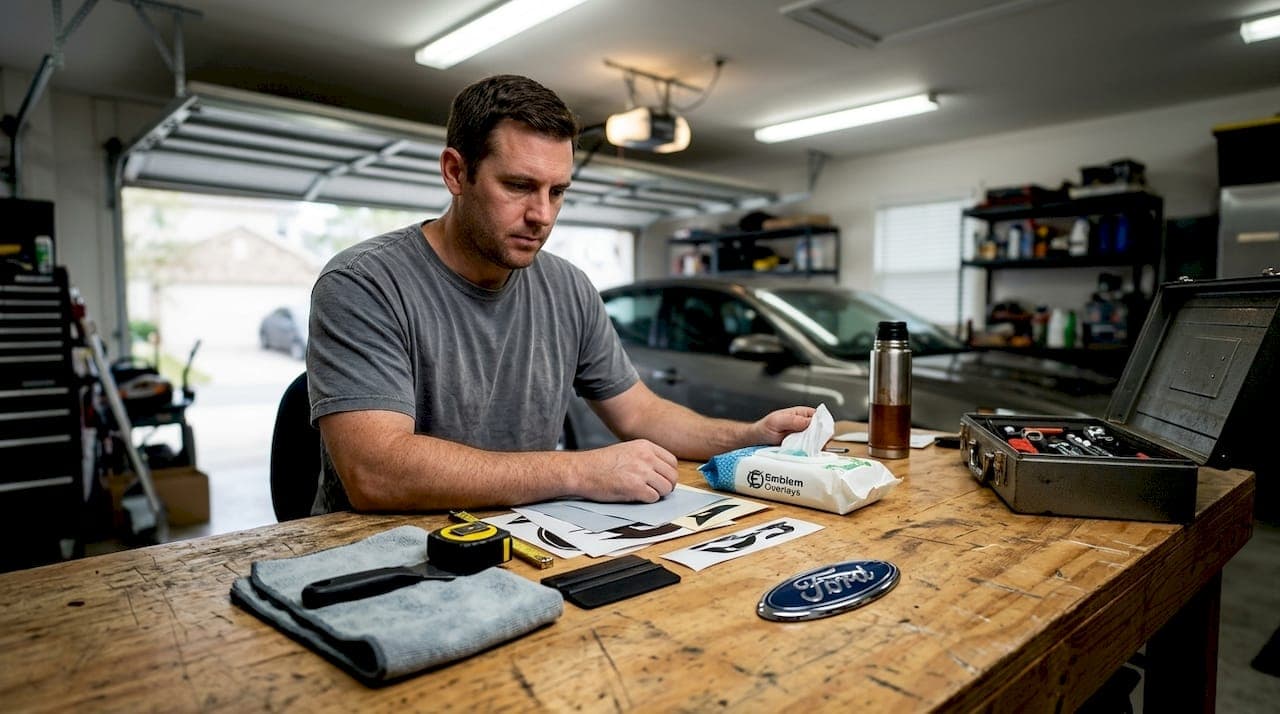
TL;DR:
- Vinyl emblem overlays allow personalized styling without damaging the vehicle or voiding warranty.
- Proper measurement, surface prep, and application techniques are key for durable, professional-looking results.
- Custom overlays enhance vehicle appearance and express owner identity affordably and easily.
Your Ford rolls off the lot looking exactly like every other one on the road. Same oval badge, same finish, same everything. For owners who care about personal style, that factory emblem is a missed opportunity. Vinyl emblem overlays fix that without drilling, painting, or voiding coverage when done right. This guide walks you through the full workflow, from picking the right materials to nailing the install and keeping your custom badge looking sharp for years. Whether you drive an F-150, a Super Duty, or a Bronco, the process is the same and the results are genuinely impressive.
Table of Contents
- What you need: Preparing for your Ford badge customization
- Step-by-step Ford badge customization workflow
- Troubleshooting: Common mistakes and how to avoid them
- Show off your results: Care, longevity, and design inspiration
- A DIY upgrade no one's talking about: Why badge overlays are the real secret to car identity
- Ready for the next level? Try custom emblem overlays
- Frequently asked questions
Key Takeaways
| Point | Details |
|---|---|
| Proper prep is crucial | Thorough cleaning and accurate measurements prevent the most common install problems. |
| High-quality materials last | Premium cast vinyl overlays offer up to 5–7 years of fade-resistant style for your Ford badge. |
| DIY delivers unique style | Custom badge overlays make your Ford stand out for minimal cost and effort. |
| Creative design options abound | From blackout to retro or themed overlays, personalization options fit all tastes. |
What you need: Preparing for your Ford badge customization
Before you touch your emblem, you need the right supplies and a clear understanding of your specific Ford's badge geometry. Skipping this step is the number one reason DIY badge jobs go sideways.
Start by understanding the Ford emblem overlay types available, since not every overlay fits every model. Badge dimensions vary significantly across Ford's lineup. The F-150 grille badge runs ~9 inches wide, while tailgate and door badges are smaller. Super Duty badges have their own proportions. Always measure your specific emblem before ordering anything.
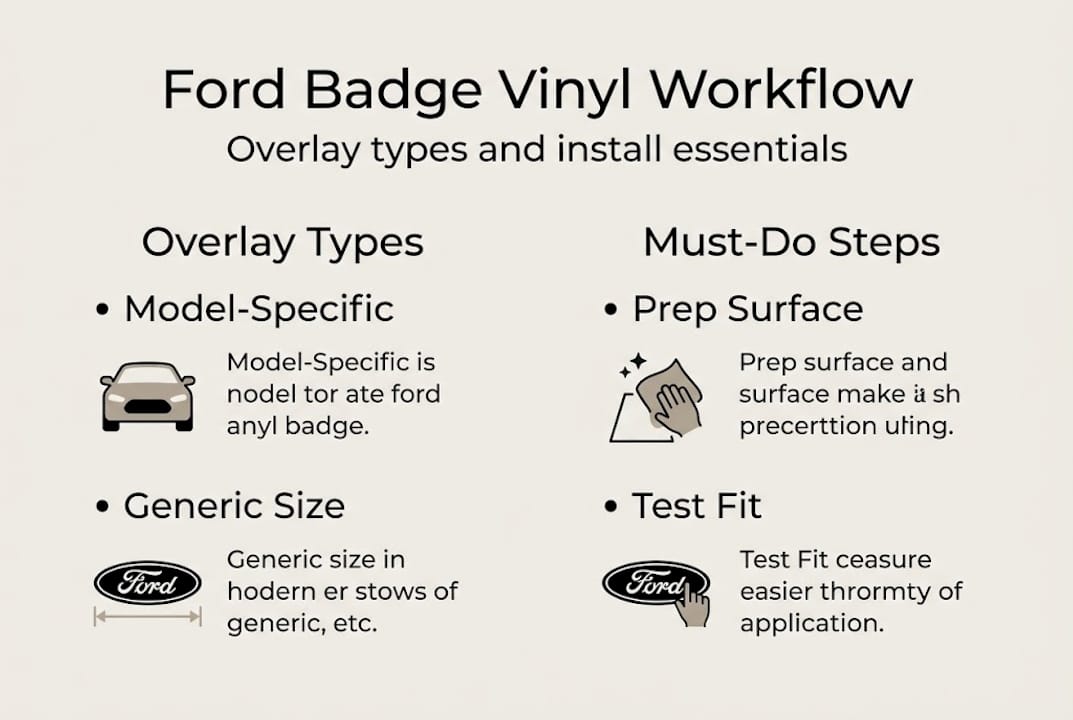
Here's a quick reference for common Ford badge sizes:
| Model | Badge location | Approximate width |
|---|---|---|
| F-150 | Front grille | ~9 inches |
| F-150 | Tailgate | ~6 inches |
| Super Duty | Front grille | ~10 inches |
| Bronco | Hood/grille | ~7 inches |
| Mustang | Grille | ~5 inches |
For materials, you'll want:
- Premium cast vinyl (3M 1080 series or Avery Dennison Supreme Wrapping Film work best)
- Isopropyl alcohol (70% or higher) for surface prep
- Plastic squeegee with felt edge to avoid scratching
- Utility knife or precision scissors for trimming
- Microfiber cloths for cleaning and drying
- Heat gun or hair dryer for conforming vinyl to curved surfaces
Surface prep is not optional. Any grease, wax, or road film on the emblem will compromise adhesion and cause your overlay to lift at the edges within weeks. Wipe the badge down with isopropyl alcohol and let it fully dry before you do anything else. Also check out emblem personalization basics to understand what finish and design choices work best for your model.
Note: Vinyl emblem overlays are a personal modification. Ford does not officially endorse or provide guidelines for vehicle vinyl customization. If your installation damages the emblem surface or surrounding paint, warranty claims for those areas can be affected. Proceed carefully.
Pro Tip: Order overlays that are pre-cut for your Ford's exact year and model. Generic sizes almost always require trimming and increase the chance of misalignment.
One more thing: newer Ford models with embossed lettering on the badge can show through thinner vinyl. If your badge has raised text, look for thicker overlays or consider a full-coverage design that accounts for the texture.
Step-by-step Ford badge customization workflow
Once supplies are ready, dive into the actual workflow, one step at a time.
Follow this sequence and you will avoid the most common installation mistakes:
- Clean the emblem with isopropyl alcohol and a microfiber cloth. Let it dry completely, at least 10 minutes.
- Measure the badge one more time with a tape measure. Confirm your overlay dimensions match before peeling anything.
- Do a dry test fit by holding the overlay (still on its backing) over the badge. Check alignment and make sure the cut matches the badge shape.
- Peel the backing slowly from one corner. For larger badges, peel halfway and work from the center outward.
- Apply the overlay starting from the center and pressing outward with your squeegee to push air to the edges.
- Smooth edges with the squeegee, applying firm, even pressure. Use a heat gun on low to help the vinyl conform to any curves.
- Trim any excess with a precision knife if needed, following the badge border closely.
- Final press across the entire overlay to ensure full contact with the surface.
For a deeper look at technique, the step-by-step Ford emblem tutorial covers model-specific nuances in detail.
One decision you'll make early is whether to go dry or wet. Here's how they compare:
| Method | Pros | Cons |
|---|---|---|
| Dry application | Faster, no drying time, stronger initial bond | Less forgiving, harder to reposition |
| Wet application | Easier to reposition, reduces bubbles during placement | Requires thorough drying, can lift if moisture stays trapped |
For small badges under 6 inches, dry application is almost always the better call. For larger grille badges, wet can give you more control. Check vinyl overlay application tips for guidance on which method suits your specific badge size.
Premium cast vinyl lasts 5 to 7 years outdoors when applied over a properly prepped surface and protected with a laminate layer. That's years of custom style with a one-time install.
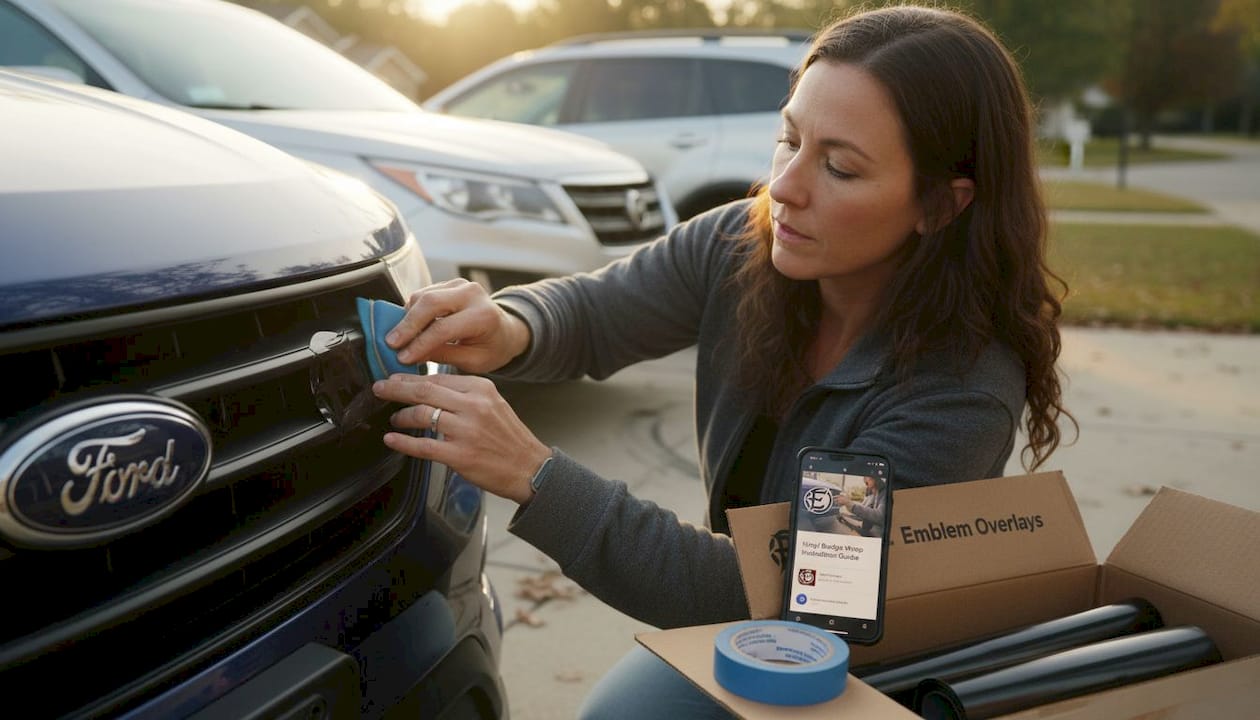
Pro Tip: Apply in the shade when temperatures are between 65 and 75 degrees Fahrenheit. Heat above 80 degrees makes vinyl tacky and hard to control. Cold below 50 degrees reduces adhesion significantly.
Troubleshooting: Common mistakes and how to avoid them
Even with a great workflow, mistakes happen. Here's how to prevent or correct them.
The most common issues Ford badge overlay installers run into fall into a few clear categories. Knowing what causes them makes them easy to avoid.
Edge lifting is the most frequent complaint. It almost always traces back to one of three causes: oily or waxy surface residue, applying in high humidity, or skipping the final press along the edges. The fix is edge sealer, a thin bead applied around the perimeter of the overlay after install. It bonds the edge to the badge surface and prevents wind and water from getting underneath.
Air bubbles that appear after install can usually be fixed within the first 24 to 48 hours. Use a fine pin to pierce the bubble at a shallow angle, then press the air out with your finger or squeegee. Bubbles that show up after a week are usually caused by moisture trapped beneath the vinyl during a wet application that was not dried long enough.
Visible emblem lettering is a problem specific to newer Ford models with embossed badges. Embossed lettering may show through on thinner overlays. The solution is to use a thicker cast vinyl or a textured design that visually masks the raised areas.
Here's a quick reference for common problems and solutions:
- Edge lifting: Clean surface again, apply edge sealer, press firmly with squeegee
- Air bubbles: Pierce with pin, smooth out, apply gentle heat if needed
- Poor adhesion: Strip and restart with fresh isopropyl alcohol wipe-down
- Misalignment: Wet method allows repositioning within the first few minutes
- Visible embossing: Switch to thicker vinyl or a design with visual texture
For more detailed guidance, the emblem overlay tips resource covers fixes for tricky installs, and enhance your car look explains how design choices affect the final appearance.
Warning: If you need to remove an overlay that has been on for an extended period, use a heat gun to soften the adhesive before peeling. Forcing it off cold can pull paint from the surrounding area and create a warranty issue.
Temperature and humidity matter more than most people expect. Avoid applying in direct sun above 80 degrees Fahrenheit, in high humidity, or on a wet surface. These conditions are the top causes of bubbling and lifting within the first few weeks.
Show off your results: Care, longevity, and design inspiration
After nailing the install, here's how to keep your custom look fresh and get inspired for upgrades.
Vinyl overlays are low maintenance, but a little care goes a long way. Wipe your badges down with mild soap and water during regular washes. Avoid high-pressure sprays aimed directly at the overlay edges, since sustained pressure can work underneath the vinyl over time. Skip abrasive cleaners entirely.
Premium cast vinyl lasts 5 to 7 years with a laminate layer and proper prep. That's a long runway for your custom look before you'd ever need to think about replacing it.
Finish choice matters more than most people realize. Matte and satin finishes resist fingerprints and minor smudging far better than gloss. Gloss looks striking in photos but shows every water spot and touch. For a daily driver, matte or satin is almost always the smarter pick.
Maintenance checklist:
- Wash with mild soap and a soft cloth, never abrasive pads
- Avoid pressure washing directly at badge edges
- Apply a UV protectant spray over the overlay once or twice a year
- Inspect edges every few months and reseal if needed
- Store the vehicle out of direct sun when possible to slow UV degradation
For design inspiration, the options are genuinely exciting. Some of the most popular looks for Ford owners include:
- Blackout overlays that replace the chrome oval with a flat black or gloss black finish
- American flag designs that add a patriotic element to the grille or tailgate badge
- Retro Ford oval patterns that reference classic badge styling from the 1960s and 1970s
- State flag overlays for owners who want to rep their home state on every drive
- Carbon fiber texture for a performance-oriented look without the cost of real carbon
Browse boost your vehicle's look for visual examples, explore subtle customization ideas for understated upgrades, or check emblem personalization guides for a full breakdown of design directions.
A DIY upgrade no one's talking about: Why badge overlays are the real secret to car identity
Most car mod conversations jump straight to wheels, exhausts, or lift kits. Those upgrades cost thousands. A badge overlay costs a fraction of that and gets noticed just as often, sometimes more.
Here's the thing about small visual changes: they create conversation. When someone notices your blackout badge or your state flag overlay, they ask about it. That's how car communities actually form, around details, not just big builds. A $30 overlay can do more for your identity in a parking lot than a $2,000 exhaust.
The emotional payoff is real too. When you install something yourself and it looks exactly right, the car feels like yours in a way it didn't before. That feeling is underrated in the mod world.
The practical emblem overlay guide lays out how to build a cohesive theme starting from the badge outward.
Pro Tip: Start with badge overlays, then use that design choice as the anchor for your car's full visual theme. It's easier to build around a detail you love than to add details to a look that feels incomplete.
The most satisfying mods are the ones only you know are there at first, until someone else notices and asks.
Ready for the next level? Try custom emblem overlays
If this guide got you excited about personalizing your Ford's badges, we've got you covered with overlays made specifically for Ford vehicles.
Our handmade emblem overlays are crafted to fit your Ford's exact badge dimensions, so there's no guessing, trimming, or frustration. We carry hundreds of designs including every state flag, blackout styles, retro patterns, and more. Whether you want something bold or something subtle, you'll find it when you browse all overlays. Skip the guesswork and go straight to a design that fits your Ford and reflects who you are.
Frequently asked questions
Will customizing my Ford badge with vinyl overlays void my warranty?
Ford does not officially endorse vinyl customization for vehicles, and if the modification damages paint or emblem surfaces, warranty claims for those areas can be denied. Take precautions, work carefully, and check your warranty terms before starting.
How do I find the right size vinyl for my Ford badge?
Measure your badge width and height before ordering, since sizes vary by model and year, with the F-150 grille badge running approximately 9 inches wide. Then order overlays sized for your specific year and model.
How long will a vinyl overlay last on my Ford badge?
Premium cast vinyl lasts 5 to 7 years outdoors when applied with proper prep and a laminate layer, making it one of the most durable and cost-effective customization options available.
What's the difference between wet and dry vinyl application methods?
Dry install bonds faster and is better for small badges, but it's less forgiving if you misalign. Wet application lets you reposition the overlay during placement but can cause bubbles if the moisture underneath isn't fully dried before the vinyl sets.