
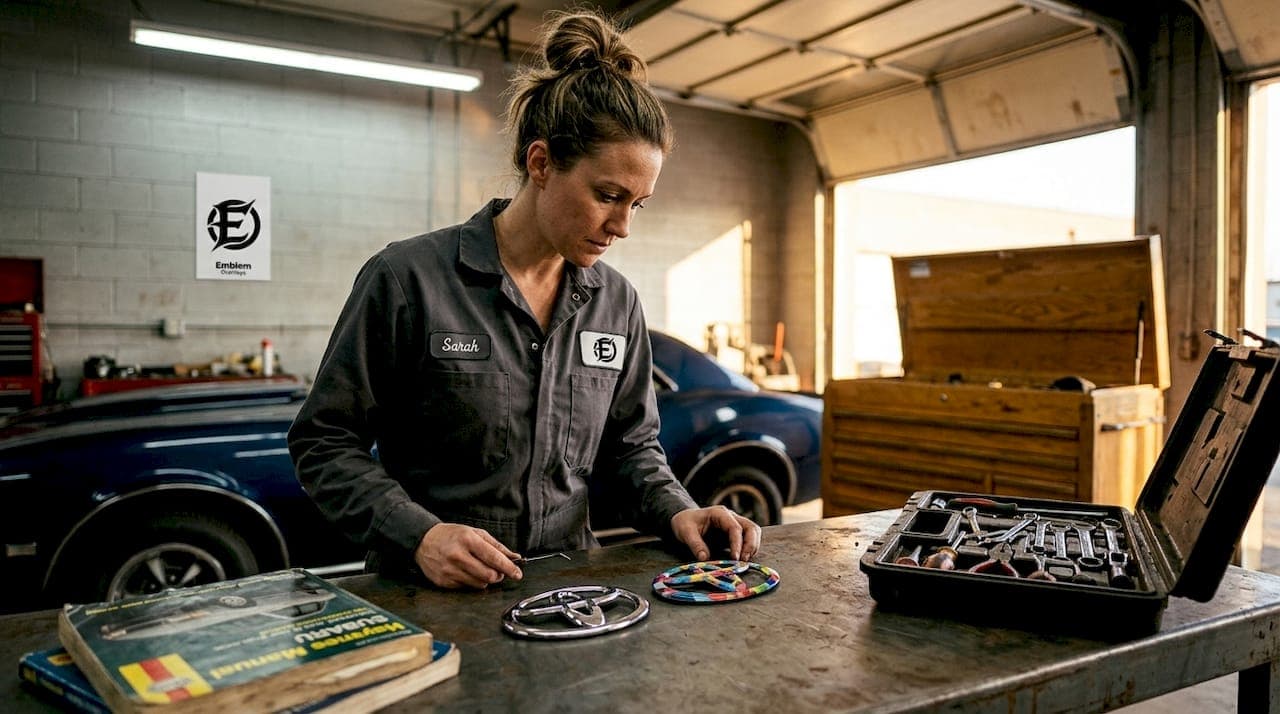
TL;DR:
- OEM emblems offer factory-fitted durability but require removal and pose a paint risk.
- Custom overlays provide flexible design options and are easy to install without damaging the vehicle.
- For most enthusiasts, overlays are a cost-effective, customizable way to personalize their vehicle's appearance.
Not all emblem upgrades are created equal, and plenty of Subaru and Ford owners find that out the hard way. Some assume a $15 overlay will look and last just like a factory badge, while others spend $60 on an OEM replacement only to scratch their paint during removal. The truth sits somewhere in the middle, and knowing where can save you money, frustration, and a trip to the body shop. This guide breaks down the real differences between OEM emblems and custom overlays so you can make a confident, informed choice for your build.
Table of Contents
- Understanding OEM emblems and custom overlays
- Cost, quality, and risk: comparing your options
- Customization and personal style: the real value of overlays
- Installation: what to expect and how to get it right
- Our take: why overlays often beat OEM for real-world drivers
- Ready to personalize your emblem? Start with trusted overlays
- Frequently asked questions
Key Takeaways
| Point | Details |
|---|---|
| OEM vs custom clarity | OEM emblems excel in fit and durability but cost more and require complex installation while custom overlays offer style and ease. |
| Personalization options | Custom overlays unlock style and color variety far beyond traditional OEM offerings. |
| Risk and installation | Overlays are low-risk and easy to install, making them perfect for first-timers and seasoned enthusiasts. |
| Value and flexibility | Most car enthusiasts get maximum value by using overlays for everyday style and reserving OEM parts for restoration needs. |
Understanding OEM emblems and custom overlays
With those misconceptions in mind, let's break down exactly what sets OEM and custom overlays apart.
OEM stands for Original Equipment Manufacturer. When you buy an OEM emblem, you're getting the same badge your vehicle left the factory with, made to the same specifications, and sourced from the same supply chain. For Ford and Subaru drivers, that means precision fit, exact color matching, and materials engineered to survive years of highway miles and weather exposure. OEM emblems for Ford offer guaranteed compatibility and durability spanning five years or more, which is a real advantage if you want a factory-fresh look with zero guesswork.
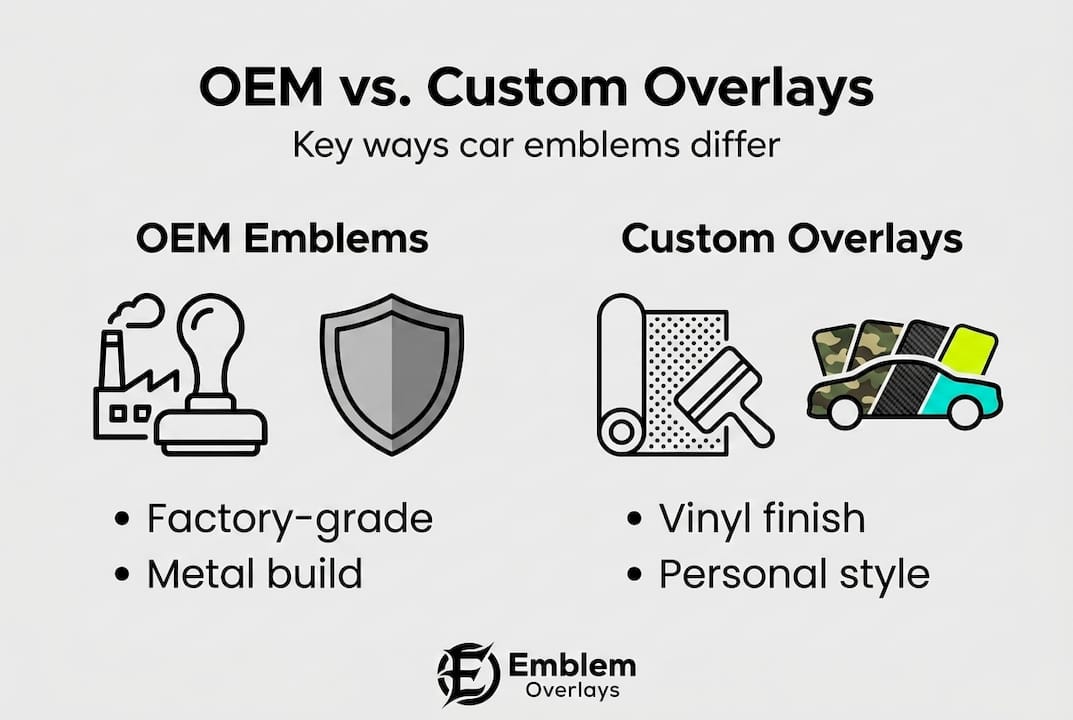
Custom overlays work differently. Instead of replacing your emblem, they layer on top of it. Most are made from cast or calendered vinyl, sometimes resin-coated for added depth and gloss. The goal is to change the look of your badge without touching the factory piece underneath. This approach has exploded in popularity because it opens up design possibilities that OEM simply can't match. Think about emblem personalization for Subaru and Ford as a way to express who you are through your vehicle, not just what trim level you bought.
Here's a quick breakdown of what separates these two options at a glance:
- OEM emblems: Made from stainless steel or ABS plastic, engineered for exact fit, require removal of the original badge, and carry a higher upfront cost.
- Custom overlays: Made from vinyl or resin, designed to apply directly over the factory emblem, require no removal, and offer far more design flexibility.
- Durability gap: Metal OEM badges handle harsh sun, road salt, and pressure washing better over the long term.
- Design gap: Overlays offer colors, finishes, and graphics that no OEM catalog ever will.
- Installation gap: OEM swaps often need professional tools; overlays are genuinely DIY-friendly.
Pro Tip: If you're unsure which route fits your goals, ask yourself one question first: do you want to restore or reinvent? OEM is for restoring. Overlays are for reinventing.
Cost, quality, and risk: comparing your options
Now that we've set the stage for what these products are, let's get into the real-world data on cost, quality, and risk.
Money is usually the first thing drivers want to talk about, and the numbers here are pretty clear. OEM emblems typically cost $35 to $60 for Ford models, while custom overlays and aftermarket options generally land between $10 and $40 with variable quality depending on the source. That price gap matters, but it's only part of the story.

| Feature | OEM emblem | Custom overlay |
|---|---|---|
| Cost | $35 to $60 | $10 to $40 |
| Material | Stainless steel / ABS plastic | Vinyl / resin |
| Lifespan | 5+ years | 2 to 5 years (quality dependent) |
| Installation | Requires emblem removal | Peel and stick over factory badge |
| Paint risk | Moderate to high during removal | Very low |
| Design options | Factory colors only | Hundreds of options |
| Reversibility | Difficult | Easy |
The quality conversation gets more nuanced when you factor in where and how you drive. If your Ford F-150 spends most of its life in Arizona sun or Minnesota winters, material quality matters a lot. A cheap vinyl overlay can bubble, fade, or peel within a season under those conditions. A high-quality cast vinyl overlay, on the other hand, can hold up for three to five years with proper care. The difference between a $12 overlay and a $35 overlay often comes down to the vinyl grade, UV resistance, and adhesive quality.
Risk is where overlays genuinely shine. Removing an OEM emblem requires heat, dental floss or fishing line, adhesive remover, and a steady hand. One wrong move and you're looking at scratched clear coat or even bare metal exposure. Overlays sidestep that entire process. You clean the surface, align the overlay, press it down, and you're done. Explore types of Ford overlays to get a sense of how wide the options really are, and check out custom overlay benefits for a deeper look at why so many drivers are switching.
Stat to know: High-quality cast vinyl overlays from reputable suppliers can maintain color and adhesion for up to five years, putting them in direct competition with OEM durability when properly installed and maintained.
Pro Tip: Always check whether an overlay uses cast vinyl or calendered vinyl. Cast vinyl is thinner, more conformable, and far more UV-resistant. Calendered vinyl is thicker and cheaper but shrinks over time, especially in heat.
Customization and personal style: the real value of overlays
Beyond function and cost, personalization is what excites most Subaru and Ford fans, and here's how overlays take it to the next level.
OEM emblems give you exactly one design choice: the factory look. That's fine if you love the stock appearance of your Subaru Outback or Ford Bronco badge. But if you want something that turns heads in a parking lot or tells a story about where you're from, OEM has nothing to offer. Custom overlays are where personality enters the picture.
The range of available designs is genuinely staggering. Custom overlays for Subaru and Ford now include options like:
- Metallic and chrome finishes that give your badge a premium, aftermarket look without the premium price
- Matte black and satin finishes for a blacked-out aesthetic that's hugely popular on trucks and crossovers
- Reflective and color-shifting vinyl that changes appearance depending on the light angle
- Themed graphics including military, sports, and regional designs
- All 50 state flags, so you can rep your home state right on your hood or tailgate
That last point is something we're especially proud of. We offer all state flag designs as emblem overlays, which means a driver from Texas can put the Lone Star on their F-150, or a Subaru owner from Colorado can show off their state pride on every drive. It's a small detail that makes a big statement.
"The best vehicle mods are the ones that feel personal, not just performative. An overlay that reflects where you're from or what you love says more about you than any wheel upgrade ever could."
The reversibility factor is also massively underrated. Because overlays sit on top of the factory emblem and don't require any permanent changes, you can swap designs whenever you want. Sold on a matte black look today but want to try chrome next season? Pull the overlay off, clean the surface, and apply the new one. Try doing that with an OEM swap. Enhancing your car's look doesn't have to mean a permanent commitment, and that flexibility is a real advantage for enthusiasts who like to evolve their builds over time.
Installation: what to expect and how to get it right
Once you've chosen your overlay or emblem type, the final decision is installation. Here are best practices that seasoned enthusiasts swear by.
Installing a custom overlay is genuinely one of the easiest modifications you can make to your vehicle. There's no drilling, no wiring, and no risk of voiding your warranty. That said, doing it right still takes a little patience and preparation. Here's the process that consistently delivers the cleanest results:
- Clean the emblem thoroughly. Use isopropyl alcohol (at least 70%) to remove all wax, grease, and dirt from the factory badge surface. Any contamination under the overlay will create bubbles or weak adhesion points.
- Dry completely before applying. Even a small amount of moisture trapped under the overlay can cause lifting at the edges. Give it a full five minutes after wiping.
- Check the temperature. Apply overlays in temperatures between 60°F and 80°F for the best adhesive bond. Cold surfaces make adhesive sluggish; hot surfaces can cause the vinyl to stretch or misalign during application.
- Align before committing. Hold the overlay over the emblem without pressing down. Confirm the alignment from multiple angles before making contact.
- Press from center outward. Use a soft cloth or squeegee to press the overlay down, working from the center toward the edges to push out any air bubbles.
- Let it cure before washing. Wait at least 24 hours before running the vehicle through a car wash or exposing it to heavy rain. This gives the adhesive time to fully bond.
The contrast with OEM installation is stark. Removing a factory emblem typically involves heating the badge with a heat gun to soften the adhesive, carefully cutting through the adhesive with a thin line, and then using adhesive remover to clean the residue without damaging the clear coat. Full OEM replacements require emblem removal and carry a real paint scratch risk, especially on older vehicles where the clear coat may already be thin or compromised.
Pro Tip: If you're installing an overlay in cold weather, warm the emblem surface with a hair dryer for 30 seconds before applying. This activates the adhesive and dramatically improves the bond.
For a more detailed walkthrough, the stepwise overlay process guide covers every step with visuals, and the practical emblem overlay guide addresses common mistakes and how to avoid them.
Our take: why overlays often beat OEM for real-world drivers
Here's our honest, experience-based view on the debate after laying out all the evidence.
The OEM vs. overlay debate often gets framed as a quality contest, and that framing misses the point entirely. OEM emblems are not inherently better for most drivers. They're just different tools for different goals. If you're restoring a classic Ford Mustang to show condition or replacing a cracked badge on a lease vehicle before turn-in, OEM makes perfect sense. But for the vast majority of Subaru and Ford enthusiasts who want to personalize their daily driver or weekend build, overlays are the smarter choice by almost every practical measure.
We've seen drivers spend $50 on an OEM badge swap, scratch their paint during removal, and end up with a look identical to what they started with. Meanwhile, a $25 overlay in matte black or a state flag design transforms the entire front-end appearance in under ten minutes with zero risk. That's not a compromise. That's a better outcome.
The durability argument for OEM is real but overstated for everyday use. Most drivers modify their vehicles every two to three years anyway. Spending more for a five-year lifespan on a badge when your tastes will change before then is not a financial win. Overlays let you boost your Subaru or Ford's look now, change it later, and never feel locked in. That flexibility has genuine value that pure durability numbers don't capture.
Our recommendation is simple: start with an overlay. If you love the result and want something more permanent years down the road, revisit OEM then. But for most enthusiasts, the overlay will do everything they need and more.
Ready to personalize your emblem? Start with trusted overlays
You've got the knowledge. Now it's time to put it to work on your actual vehicle.
We design and handcraft vinyl emblem overlays specifically for Subaru and Ford vehicles, with hundreds of designs built to fit your factory badge perfectly. From all 50 state flags to metallic finishes and blacked-out styles, every overlay is made to deliver a clean, professional look without any of the installation risk that comes with OEM swaps. Browse top emblem overlay options to find your perfect design, or explore our full collection of handmade emblem overlays built for drivers who take their vehicle's appearance seriously. Your next favorite mod is one overlay away.
Frequently asked questions
Do vinyl overlays last as long as OEM emblems?
Vinyl overlays typically offer good durability but fade faster than metal OEM emblems, especially in direct sunlight. High-quality cast vinyl overlays can last three to five years with proper care and UV-resistant materials.
Is it risky to remove my factory emblem myself?
Yes, OEM emblem removal carries a real paint scratch risk, particularly on vehicles with aging clear coat. Custom overlays apply directly over the factory badge, eliminating that risk entirely.
Can overlays be customized with specific colors or logos?
Absolutely. Custom overlays come in a wide range of finishes, colors, and graphic designs, including all 50 state flags, metallic options, matte styles, and themed graphics tailored to your personality and vehicle.
Do overlays affect the resale value of my vehicle?
High-quality overlays are removable and leave no permanent marks, so they don't negatively impact resale value. If you're preparing a vehicle for sale and want the factory look restored, simply remove the overlay before listing.